
They've taken over the shelves and the beauty vocabulary; we mix them up, we fear them, we adore them. But what do acids actually do — and how do you know which one is right for your skin?

In short
Unlike a scrub, which lifts away dead cells through friction, exfoliating acids dissolve them: they break the bonds holding dead cells to the surface, and the skin sheds them on its own. Two main families share the work. AHAs, water-soluble, smooth and brighten the surface. BHA, oil-soluble, descends into the pores to clear them. Choosing the right one simply means knowing where your skin needs the work done.
Exfoliating without scrubbing
For a long time, exfoliating meant scrubbing: a scrub, micro-grains, friction meant to dislodge dead cells. Acids changed the method. Rather than tearing cells away by abrasion, they dissolve the substance that keeps them stuck to the surface — an exfoliation without grains, without friction, and often better tolerated.
Because the skin renews itself on its own, in principle. Roughly every four weeks, its surface cells detach to make way for new ones. But that cycle slows with age, dehydration and sun, and dead cells accumulate: the complexion dulls, the texture thickens, light no longer passes through. The exfoliating acid restarts this natural mechanism — it dissolves the adhesion, the skin lets go, and radiance returns.
The question is which acid, because they don't all reach the same depth. And that depth, curiously, comes down to a single criterion: their affinity for water or for oil.

Exfoliating acids: exfoliation without grains, without friction
AHAs: light on the surface
AHAs — alpha-hydroxy acids — are water-soluble. And since the skin's surface holds a great deal of water while sebum is oily, this affinity keeps them exactly where they excel: on the surface, smoothing, refining and brightening. This is the family of renewal, radiance and refined skin texture.
They form a small family with distinct temperaments.
Glycolic acid is the best known and the most incisive. Its molecule, the smallest of the AHAs, penetrates quickly and acts like a gentle surface peel: it's the acid for thick, rough or dull skin, which it reveals and brightens.
Lactic acid is more delicate. Naturally present in the skin, it exfoliates gently while holding water — a rare humectant quality that makes it the AHA for sensitive or dehydrated skin, which gains suppleness rather than dryness.
Mandelic acid, derived from almonds, is one of the largest AHAs. Its big molecule penetrates more slowly than glycolic, making its action gradual and particularly well tolerated — an excellent choice for sensitive skin that wants to exfoliate without being rushed.
Tartaric (from grapes), malic (from apples) and citric (from citrus) acids round out the family. Each refines the texture and revives radiance, often in synergy with one another; citric adds an antioxidant note. Rarer still, galactaric acid also defends the skin against pollution and outside stressors.
They all share the same signature: smoother skin, a brighter complexion, a more even surface. But none of them descends into the pores. For that, you need an acid that isn't afraid of oil.
And PHAs, the gentlest of all
A newer family deserves a mention: the PHAs, or poly-hydroxy acids — such as gluconolactone and lactobionic acid. Their molecules, larger still than those of the AHAs, stay on the skin's surface and work with remarkable slowness. The result: they exfoliate without irritating, hold on to hydration and provide antioxidant protection. This is the family for sensitive, dry, reactive or rosacea-prone skin — those for whom even a gentle AHA can be too much. A precious detail: unlike AHAs and BHA, they don't increase the skin's sensitivity to the sun. They're found notably in professional treatments.

AHA on the surface, BHA in the pores: it all comes down to affinity with water or oil
BHA: the descent into the pores
BHA — beta-hydroxy acid, almost always salicylic acid — has exactly this quality: it is oil-soluble. And since sebum builds up in large amounts inside pores clogged by an excess of keratin and dead cells, like attracts like. That's what lets the BHA plunge into the sebum, where AHAs, being water-soluble, stay on the surface.
Once inside the pore, it dissolves the dead cells and keratin blocking it and frees the sebum trapped within: it clears the pore from the inside. It's the acid for combination-to-oily skin, enlarged pores, blackheads and blemishes: it refines the surface while working in depth. And because it dissolves the keratin that blocks the pore (a so-called keratolytic action), it also helps soothe the redness that often accompanies blemishes.
If AHAs brighten, BHA unclogs. One beautifies the surface, the other purifies the depths — and it all comes down to that simple difference between water and oil.
So, AHA or BHA?
The question pits the two families against each other when in fact they complement one another. The right instinct isn't to pick a side, but to start from your skin.
A dull complexion, rough skin, marked by time or sun, lacking radiance? AHAs are made for that. Skin that shines in the T-zone, with visible pores, prone to blackheads and blemishes? BHA is made for it. Skin that ticks both boxes — and there are many? Then the two families can work together, the AHA on the surface, the BHA in depth, provided you go gradually.
Because acids call for a single discipline: moderation. Three principles are enough. Start slowly, two to three times a week rather than every day. Don't stack everything at once: a retinol, a vitamin C and three acids on the same evening is a guaranteed irritation. And never exfoliate without protecting, because most acids make the skin more sensitive to the sun — a daily sunscreen isn't an option, but the very condition of their effectiveness.
After the acid, the barrier
One last word, because it ties this article to the ones around it. To exfoliate is to remove, and removing — however gently — puts a demand on the skin barrier. That's why a well-managed exfoliating routine always comes with a repairing gesture: generous hydration to plump, and lipids to rebuild what exfoliation has laid bare.
It's the logic of a routine thought through as a whole: you exfoliate to reveal, hydrate to plump, repair to protect. Each gesture calls the next — and it's this barrier, the cement of lipids that keeps the skin supple and watertight, that we'll be talking about very soon, right here.
Exfoliating acids in the Laboratoire Dr Renaud collection
To find these actives in our treatments:
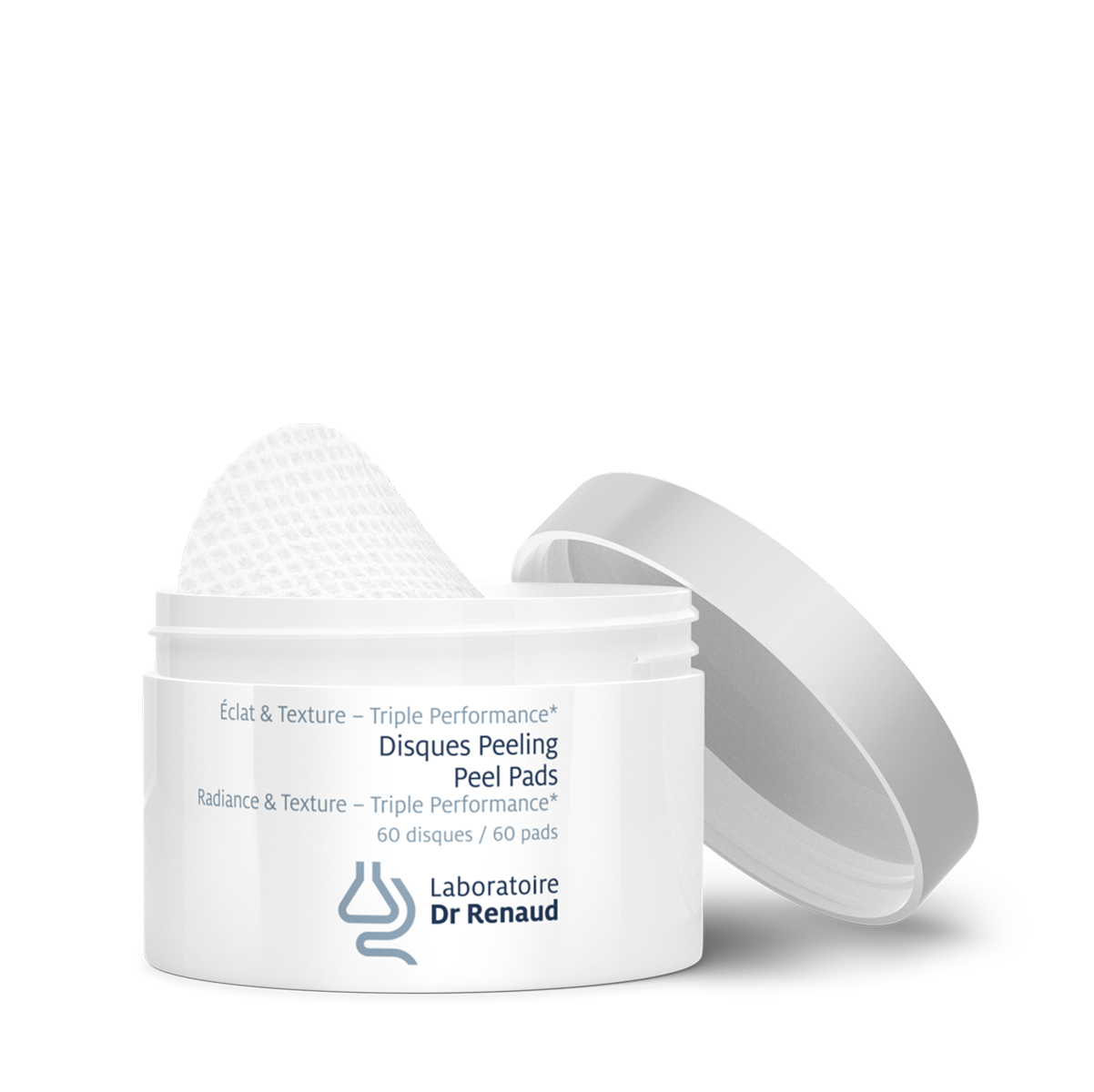
For radiance and renewal (AHA) — the Peeling Discs combine several AHAs (lactic, malic, tartaric) to refine the texture and revive the complexion's light.
For pores and blemishes (BHA) — the SeboBalance Spot Control and the SeboBalance Purifying Mask put salicylic acid to work for combination-to-oily skin, helping to clear and refine the surface.
To combine both — the Clear Up range pairs AHAs (glycolic, lactic, malic, tartaric) and BHA (salicylic) in one targeted routine, for skin seeking radiance and clarity.

Frequently asked questions

What's the difference between AHA and BHA?
Can you use AHA and BHA together?
How often should you exfoliate with acids?
Are exfoliating acids suitable for sensitive skin?
Do you need sunscreen when using acids?
To find out which acids suit your skin and at what pace, consult a Laboratoire Dr Renaud esthetician.