
Your skin makes it naturally — and loses half of it between the ages of twenty and fifty. It's time you were properly introduced to hyaluronic acid.

In short
Serum or cream? Both — because they don't do the same job. The serum, light and concentrated, carries hyaluronic acid into the skin and draws water in; the cream provides the lipids that keep it from evaporating. One hydrates, the other holds — applied in that order, they complete each other.
The molecule your skin makes — less and less of it
You already have some, right now, in your dermis. Hyaluronic acid is a molecule the skin produces naturally, a sugar able to capture and hold a great deal of water at the heart of the tissues. It's what gives a child's cheeks that bounce no cream has ever managed to imitate. As long as it is plentiful, the skin holds itself up, plumped with water from within.
It leaves on tiptoe, and that's exactly the trap. Between the ages of twenty and fifty, the amount in your skin drops by half. No alarm, no morning of reckoning: simply a complexion that loses its glow, fine lines tracing themselves where the water has gone, a facial contour that softens a little too much. It's on this observation that aesthetic medicine is built: filler injections reintroduce hyaluronic acid where it has grown scarce, restoring volume to the skin.
Hence a question cosmetics long asked without knowing how to answer it: what if you could regain part of that effect without the needle? For a long time, the answer ran into a physical obstacle. The hyaluronic acid molecule is very large — too big to cross the skin's surface and reach the dermis. Applied as is, it stays at the door.
Cosmetic science took years to work around that obstacle. Its solution comes down to a single word: size.

Hyaluronic acid: one molecule, several sizes, several roles
What labels almost never tell you...
Here is what separates a serious treatment from a pretty promise: on a label, "hyaluronic acid" doesn't say what size of molecule is meant. And that's the whole question, because there are several — and they don't do the same job.
The large molecule, known as high molecular weight, is the one that does not penetrate. It stays on the surface, and that's where it excels: it forms an invisible, non-occlusive film that slips into every fine line, fills it from above and limits water evaporation. The effect is immediate — the skin looks smoothed, taut, rested — but it plays out above the epidermis, like a veil drawn across the surface.
The small molecule, of low molecular weight, obtained through biotechnology, is fine enough to pass that first barrier. It hydrates the upper layers of the skin, this time lastingly, and supports their regeneration from within.
Then there is the most elegant path, the one that finally answers the question of the needle: not to deposit any hyaluronic acid at all, but to reactivate the one the skin makes itself. Certain actives — such as NAG-6P, one of the two building blocks your cells use to assemble the molecule — awaken this natural production deep in the dermis, precisely where conventional creams never reach. You no longer fill from above: you give the skin the means to fill itself.
A well-designed treatment doesn't choose between these three paths: it brings them together. It still has to carry them into the skin, then keep them there — and that's where two distinct products come into play.
Serum and cream: the question isn't which, but in what order
It's probably the question you're asking as you read this — it's also the most frequent one in the treatment room. It rests on a stubborn misunderstanding: we picture serum and cream as two intensities of the same thing, one more "lightweight," the other more "rich." In reality, they don't do the same job.
The serum is a water-textured concentrate. It penetrates within seconds and carries the actives — the different sizes of hyaluronic acid, the precursors, the peptides — to their workstation. Applied first, on clean skin, it's the one that draws water in and does the deep work.
The cream comes next, and its role is almost the opposite. It provides the fatty substances the serum doesn't contain, nourishes the surface and closes the routine: it holds, for twenty-four hours, the water the serum drew in. To skip it is to water a garden without ever mulching it — the water seeps in, then evaporates at once.
The serum hydrates, the cream holds. That's the whole answer — and it's why both, in that order, are worth far more than either one alone.
InnovHyal: three sizes brought together in one routine
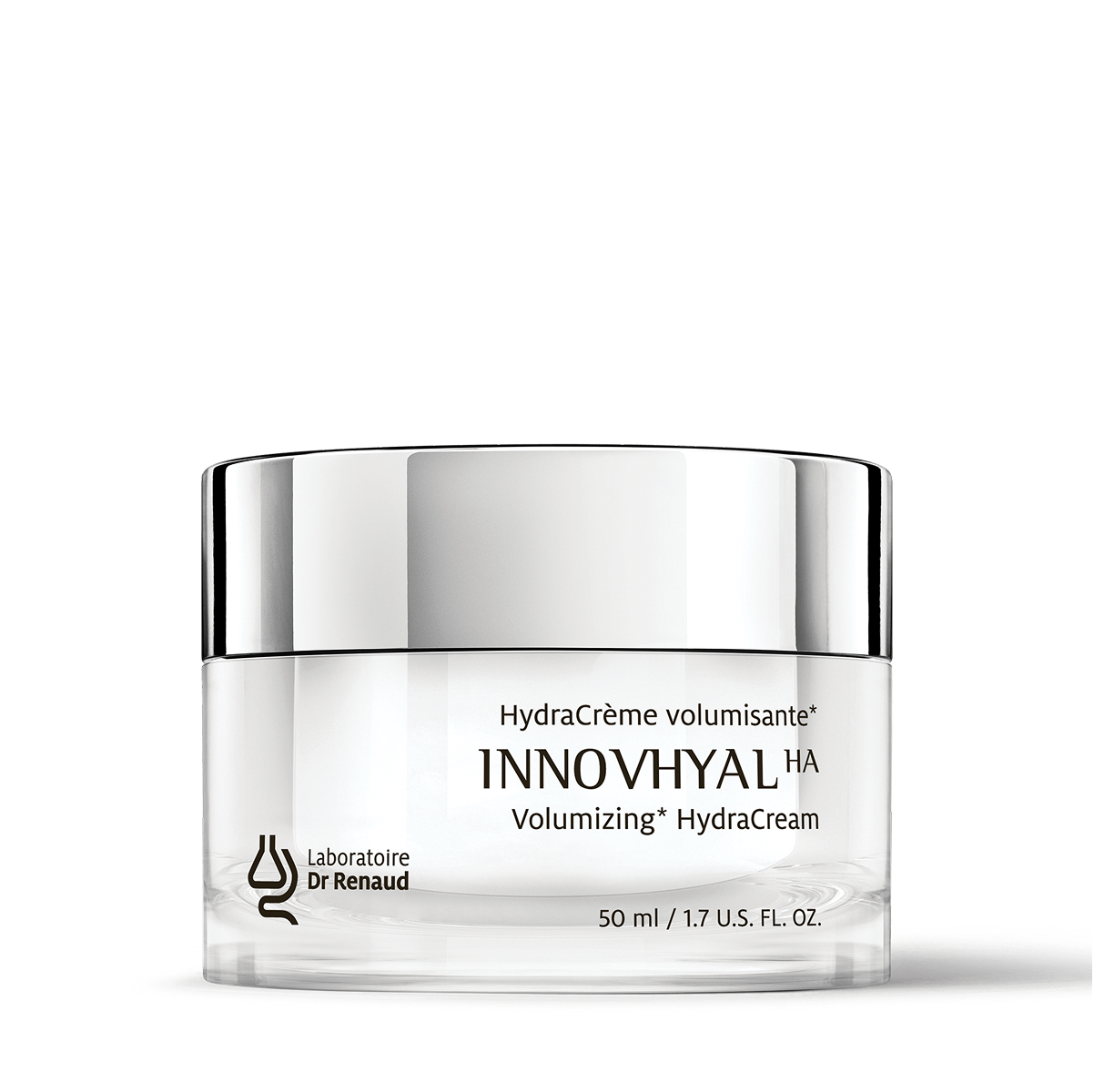
The duo InnovHyal Volumizing HydraSerum and InnovHyal 24-hour Volumizing HydraCream by Laboratoire Dr Renaud was built on this very mechanism — and on the same ambition of reproducing the filling effect, without the needle.
The serum works on all three fronts at once. On the surface, its high molecular weight hyaluronic acid smooths and fills fine lines. In depth, InnovHyal Technology — the exclusive pairing of NAG-6P and Rosmarinyl glucoside — reactivates the natural production of hyaluronic acid and protects what already exists, by neutralizing the enzyme responsible for breaking it down. To this is added Diffuporine, a peptide that reopens the water channels of the epidermis: on its own, in a clinical study on dry skin, it increased hydration by 37.6% after two hours, and by 130.9% after 56 days.
The cream then takes over. Richer, its emulsified texture nourishes the surface and prolongs hydration through four forms of hyaluronic acid — including patented microspheres that escort the large molecules down into the deeper layers, where they act like a filler, with a smoothing effect noticeable within the first hour. Niacinamide and ceramides round out the formula: together, they support the skin barrier while the hyaluronic acid draws water in.
The ritual itself takes two steps. Morning and evening, on perfectly cleansed skin: one to two pumps of serum over the face and neck, applied with light effleurages, then a small amount of cream to seal. As a course of treatment, right down to the last day of the bottle — because here, everything comes down to consistency.

The InnovHyal duo: the serum draws water in, the cream holds it
You've drawn the water in. Will it stay?
One last thing, which opens a chapter to come. Hyaluronic acid draws water into the skin, but it isn't what keeps it there. That role belongs to the lipids — ceramides, cholesterol, fatty acids — the cement that makes the epidermis watertight and that age depletes just as much as the rest. The InnovHyal HydraCream already supports this barrier while it hydrates; but supporting is not rebuilding.
When the barrier is compromised — by age, menopause, a drying treatment — it calls for the three essential lipids in their proper proportion. Hydrating such skin without repairing its barrier is like filling a bathtub with a leaking plug: the water goes in, and escapes just as fast. This is precisely the domain of Triple Lipid, the regenerating emulsion by Laboratoire Dr Renaud that restores ceramides, cholesterol and fatty acids in their physiological 1:2:1 ratio — with cholesterol leading, that barrier ingredient we'll be returning to very soon, right here. Until then, one simple rule: hydrate with method, and keep an eye on the plug.
Frequently asked questions

Hyaluronic acid serum or cream: which should you choose?
Does hyaluronic acid really penetrate the skin?
At what age should you start?
Can it be combined with other actives?
How long before you see results?
To build the hydration routine that truly suits your skin, consult a Laboratoire Dr Renaud esthetician.